
Janaki Mandir
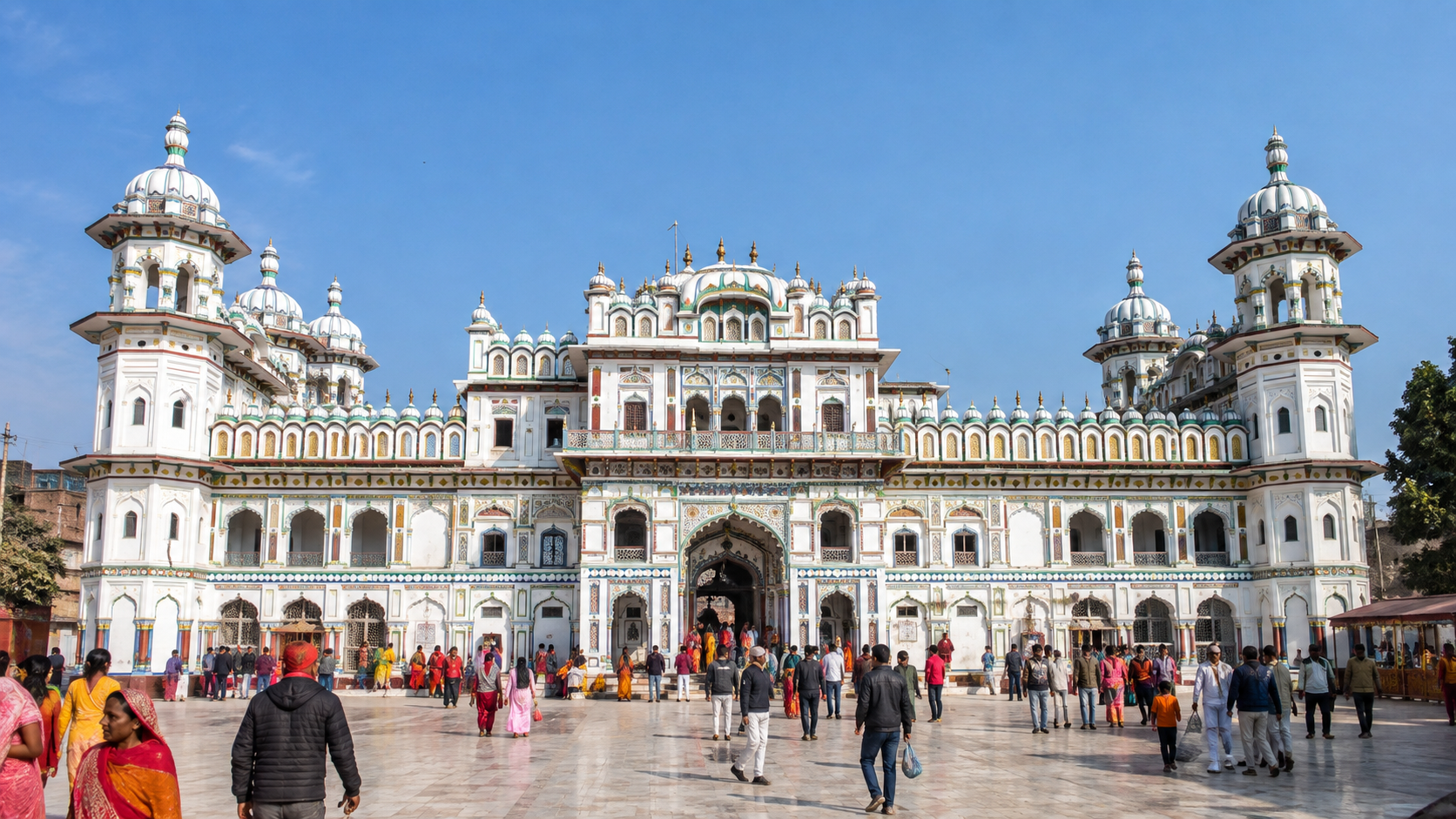
Janaki Mandir is the principal pilgrimage landmark of Janakpur, Nepal, dedicated to Goddess Sita or Janaki. The grand three-storey temple combines local and Mughal-influenced architecture and draws pilgrims from Nepal and India. This guide covers its religious importance, history, darshan, travel routes, seasonal planning, accommodation and nearby sacred places.
Janaki Mandir, Janakpur: At a Glance
Janaki Mandir is the best-known Hindu pilgrimage site in Janakpur, in Nepal's Madhesh Province. Dedicated to Goddess Sita, or Janaki, the temple is closely associated with Janakpur's identity as the sacred city of Mithila and with the Ramayana tradition. Nepal Tourism Board describes Janakpur as an important pilgrimage centre and identifies Janaki Mandir as the city's principal attraction.
For pilgrims travelling from India, the attraction is not limited to the temple itself. A visit can be combined with nearby shrines, sacred ponds and the wider religious landscape of Janakpur. The city is also an important centre of Maithili culture, making a Janakpur pilgrimage as much a cultural journey as a temple visit.
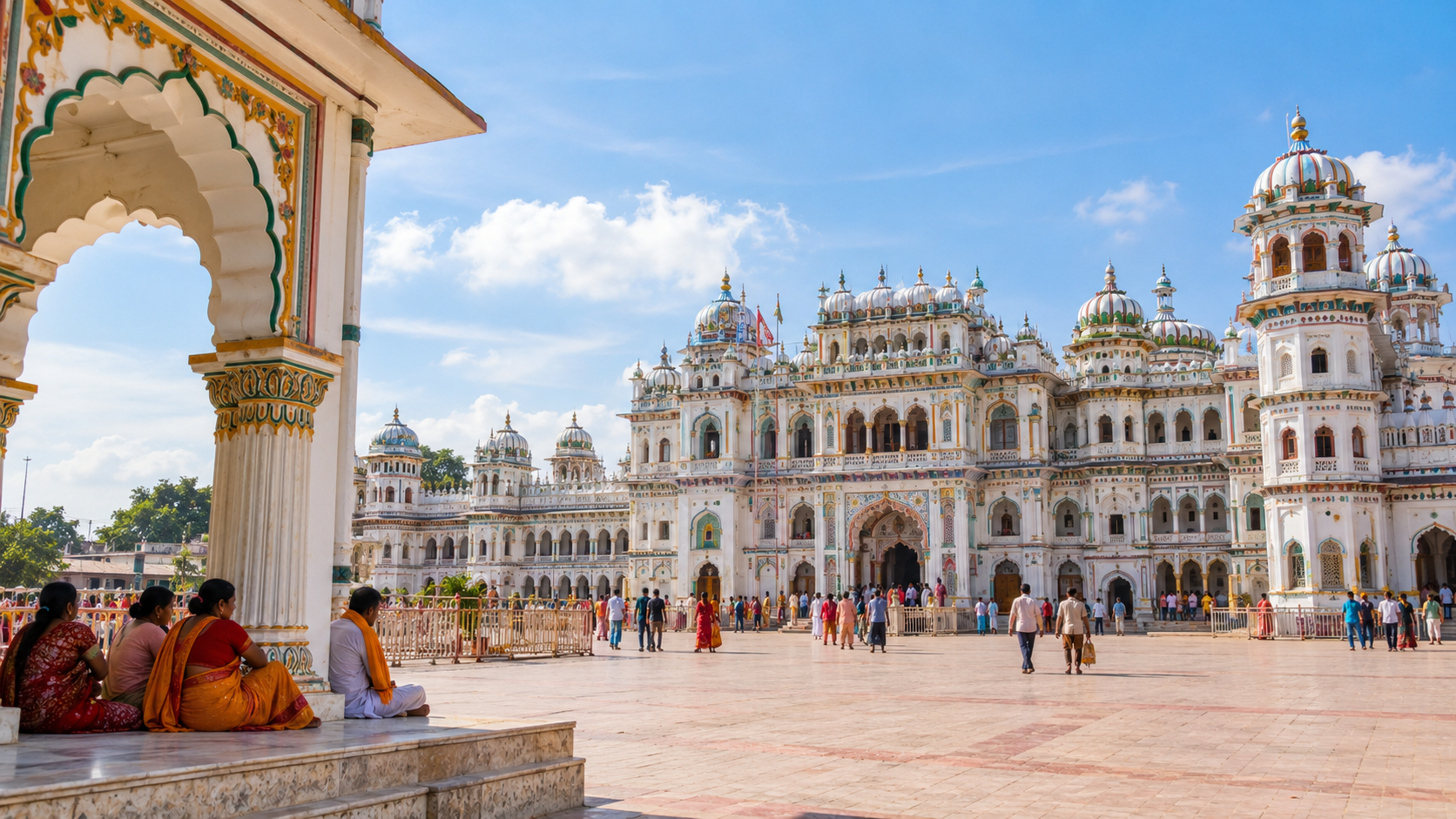
The present Janaki Mandir is a striking three-storey structure with numerous rooms and a distinctive architectural character. Nepal Tourism Board records its construction in 1874 and describes a blend of Mughal and local architectural influences.
Why Janaki Mandir Is Important
Janakpur occupies a central place in Hindu tradition because of its association with Sita, the heroine of the Ramayana and wife of Lord Rama. In the traditional account, Sita was the daughter of King Janak, the ruler of the ancient Mithila kingdom. This is why she is also known as Janaki.
The religious identity of Janakpur is therefore strongly connected with Sita. Nepal Tourism Board describes the city as the birthplace of Janaki or Sita and notes its long-standing importance to Indian pilgrims.
The temple is also connected with the traditional account of the marriage of Rama and Sita. The nearby Vivah Mandap is regarded as the place associated with their wedding and is an important stop for pilgrims visiting Janakpur.
These associations should be understood as part of Hindu religious tradition rather than treated as independently verified archaeological facts. UNESCO's Tentative List entry for the Ram Janaki Temple similarly describes the site's importance through Vedic literature and the Ramayana tradition.
Janaki Mandir History and Architecture
The present temple dates to the late 19th century. Nepal Tourism Board states that Janaki Mandir was constructed in 1874 and attributes its construction to Rani Brishbhanu Kunwari of Tikamgarh in India. It describes the building as a three-storey temple with 60 rooms and a mixture of Mughal and local architectural elements.
The temple is sometimes referred to as the Nau Lakha Mandir, a name associated with the traditional account of its construction cost. Nepal Tourism Board uses this name in its pilgrimage information for Janakpur.
One of the most noticeable features for visitors is the temple's palace-like appearance. Its domes, arches and ornamented exterior give it a character quite different from the tiered pagoda-style temples found elsewhere in Nepal. The nearby Ram Mandir provides an interesting architectural contrast because it follows a pagoda form.
UNESCO currently lists Ram Janaki Temple on Nepal's Tentative List rather than as an inscribed World Heritage Site. Its entry identifies the site's religious and cultural significance and describes its architecture as combining classical and neo-classical elements with fortification-like features.
Janaki Mandir Darshan and Timings
Temple timings can vary according to daily worship, festivals and local arrangements. Published visitor information is not completely consistent, so pilgrims should avoid planning an important journey around a single online timing.
Current travel references commonly report morning and evening visiting periods, with a midday interval. One recent Janakpur visitor source lists 5:00 AM to 12:00 PM and 4:00 PM to 9:00 PM, while other sources publish different daily schedules.
For a practical visit:
- Plan to arrive early if morning darshan is important to you.
- Allow extra time during Ram Navami, Vivah Panchami and other major festivals.
- Expect larger crowds during important religious celebrations.
- Confirm the day's darshan and aarti schedule locally before setting out.
- Follow instructions from temple authorities regarding photography and access to restricted areas.
There is no reliable basis for promising a fixed darshan duration or a guaranteed queue-free visit. Festival days can be substantially busier than ordinary days.
Temple Etiquette for Pilgrims
Janaki Mandir is an active place of worship, not simply a heritage monument. Visitors should dress modestly and behave respectfully within the temple complex.
A few simple practices make the visit easier:
- Wear clothing suitable for a Hindu place of worship.
- Remove footwear where required.
- Keep phones on silent around worship areas.
- Follow signs and instructions from temple staff and security personnel.
- Do not enter restricted areas or attempt to cross barriers for a better view.
- Ask before photographing priests, devotees or religious ceremonies.
- Keep offerings and personal belongings organised.
- Avoid blocking entrances or worshippers while taking photographs.
During busy festival periods, patience is particularly important. The experience of darshan can be very different from an ordinary weekday visit.
Best Time to Visit Janaki Mandir
Janakpur has a subtropical Terai climate. Nepal Tourism Board notes that summers can be very hot, winters are comparatively mild and monsoon conditions generally affect the region from June to September.
For comfortable pilgrimage travel, the cooler months are generally more practical than the peak summer period. The period around the major Ramayana-related festivals is especially significant for devotees, but it also brings much heavier crowds.
Festival Season
Vivah Panchami is one of the most important occasions in Janakpur. It commemorates the traditional marriage of Rama and Sita and is observed around November or December. Nepal Tourism Board notes that large numbers of devotees visit Janakpur for the celebration.
Ram Navami, associated with the birth of Lord Rama, is another important pilgrimage period.
If your priority is a quieter darshan, travelling outside major festival dates is usually more practical. If your priority is experiencing Janakpur's major religious celebrations, expect crowded streets, busy temple surroundings and greater demand for accommodation and transport.
How to Reach Janaki Mandir
Janaki Mandir is located in the centre of Janakpur, so travellers arriving in the city can reach the temple using local road transport.
From Janakpur Airport
Janakpur Airport is the city's domestic airport and is about 4 km from Janakpur. Buddha Air identifies the airport as JKR and confirms regular domestic connectivity, including direct Kathmandu-Janakpur services.
From the airport, travellers can continue into the city by local taxi or other available local transport. Actual availability and fares can change, so it is sensible to confirm the current option on arrival.
From Kathmandu
For travellers beginning their Nepal journey in Kathmandu, flying is the quickest practical option. Nepal Tourism Board states that Janakpur is about 390 km by road from Kathmandu and that flights connect the two cities.
Buddha Air currently lists Kathmandu-Janakpur flights and a flight duration of around 30 minutes, although schedules can change because of airline operations, weather and air-traffic conditions.
Road travel is another option for travellers who prefer an overland journey, but it takes considerably longer and conditions can vary.
From India
Janakpur is particularly relevant to Indian pilgrims because of its close religious and cultural connection with the Mithila region. Travellers from northern India commonly plan the journey through the Nepal-India border region before continuing to Janakpur.
A practical route depends heavily on your starting city. Travellers from Bihar and nearby parts of North India should check the current cross-border road and rail arrangements before departure, including passport or accepted travel-document requirements, border procedures and transport availability.
Nepal's railway network also serves the Janakpur region, and the Nepal Railway Company continues to publish operational notices and timetable-related updates.
Because cross-border transport schedules can change, verify the current service before booking connecting travel.
Getting Around Janakpur
Janakpur is a relatively compact pilgrimage city around its central religious attractions. Local transport is useful for reaching temples and ponds beyond an easy walking circuit.
Auto-rickshaws and other local vehicles are commonly used for short journeys. For several temple visits in one day, agree on the fare and route before starting the ride where a meter is not being used.
Walking can be practical around the central Janaki Mandir area, particularly when visiting nearby religious sites. However, traffic, heat, crowds and uneven pedestrian conditions can make walking less comfortable during busy periods.
If travelling with elderly family members or anyone with limited mobility, allow additional time and arrange local transport rather than assuming that every attraction will be easy to reach on foot.
Nearby Places to Visit
Janaki Mandir works well as the centrepiece of a wider Janakpur pilgrimage.
Vivah Mandap
Located beside Janaki Mandir, Vivah Mandap is traditionally associated with the marriage of Rama and Sita. It is one of the most relevant companion sites for devotees visiting the main temple.
Ram Mandir
Ram Mandir is another important temple in the area. Its pagoda-style architecture makes it visually distinct from Janaki Mandir, and Nepal Tourism Board identifies it as one of the significant religious sites around the main temple.
Laxman Temple and Other Shrines
The wider Janakpur pilgrimage circuit includes Laxman Temple, Sankat Mochan Temple and Hanuman Temple. Nepal Tourism Board also highlights several other temples that can be included in a longer temple tour.
Ganga Sagar and Dhanush Sagar
Janakpur is known for its sacred ponds, which form an important part of the city's religious landscape. Ganga Sagar and Dhanush Sagar are among the better-known sites.
Dhanushadham
Dhanushadham is another pilgrimage destination associated with the Ramayana tradition and can be considered if you have additional time beyond central Janakpur. Nepal Tourism Board includes Dhanushadham among the area's religious attractions.
Stay Near Janaki Mandir
Staying in central Janakpur is usually the most convenient choice for pilgrims who want early morning darshan and easy access to nearby temples.
When choosing accommodation, consider:
- Distance from Janaki Mandir rather than relying only on the hotel's city-wide location.
- Availability of early breakfast if you plan morning temple visits.
- Lift access if travelling with elderly family members.
- Attached bathroom and reliable water supply.
- Transport arrangements for airport or railway transfers.
- Cancellation terms during festival periods.
Demand can rise considerably around Vivah Panchami and other major festivals. Booking earlier is therefore sensible if your travel dates are fixed.
Do not assume that a hotel described as “near Janaki Mandir” will be quiet or suitable for elderly travellers. Central pilgrimage areas can be lively, especially around festival dates.
Accessibility and Practical Planning
Janaki Mandir is an active historic temple, so visitors should plan with realistic expectations rather than expecting the facilities of a modern tourist attraction.
For elderly pilgrims, consider travelling with a companion who can assist with footwear, belongings and movement through crowded areas. If anyone in your group has difficulty standing for long periods, ask locally about the day's queue arrangements before joining a busy darshan line.
During summer, carry drinking water, use sun protection and avoid unnecessarily long outdoor waits during the hottest part of the day. During the monsoon season, allow additional travel time because rain can affect road conditions and local movement.
Festival visits require the most planning. Transport, accommodation, temple surroundings and pedestrian areas can all become much busier than on ordinary days.
A Simple Janakpur Pilgrimage Plan
For a first-time visitor, the following structure keeps the day manageable:
- Start with morning darshan at Janaki Mandir.
- Visit Vivah Mandap and the nearby Ram Mandir.
- Explore one or more nearby temples according to your time and mobility.
- Visit Ganga Sagar or another sacred pond.
- Take a break during the hotter part of the day.
- Continue with additional Janakpur temples or cultural attractions.
- Return to the temple area for evening worship if it fits the day's schedule.
If you have two days, keep the first day focused on central Janakpur and use the second for places farther from the main temple, such as Dhanushadham.
Plan Your Janaki Mandir Visit
A visit to Janaki Mandir is best approached as a pilgrimage rather than a checklist of sightseeing stops. The temple's importance comes from its connection with Sita and Janakpur's wider place in the Ramayana tradition, while the surrounding temples, ponds and Mithila culture give the journey greater depth.
For Indian travellers, advance planning is particularly useful when the journey involves a land border, connecting train or flight, and a festival-season stay. Check current transport schedules, border requirements, temple timings and local arrangements close to your travel date, since these can change.
If you are planning a Janaki Mandir pilgrimage and would like help organising the route, transport, stay and sightseeing around Janakpur, Trip to Yatra can help you plan the journey around your dates and travel preferences.